There's lots of cool stuff coming up at the A.G.O., check out their site for more info: https://ago.ca/
First of all, starting today (May 25th) and going for the next year for sure,
anyone under 25 gets in free!!!!!
Also, annual passes are $35!!!!!
A few great changes from C.E.O. Stephan Jost- thank you!
I can't wait to check out:
Yayoi Kusama's Infinity Mirrored Room (now open and part of the permanent collection)
Brian Jungen: Friendship Centre (opening June 20th)
- Patrick
Showing posts with label art history. Show all posts
Showing posts with label art history. Show all posts
Saturday, May 25, 2019

Wednesday, May 8, 2019
French Elements and Principles of Design Handouts and Worksheets
Les Éléments et Principes de Design!
I have uploaded French Elements and Principles of Design Handouts and Worksheets to my Teachers Pay Teachers site:
https://www.teacherspayteachers.com/Product/Les-Elements-et-Principes-de-Design-4559755
These are great to use with any age group.

Patrick
I have uploaded French Elements and Principles of Design Handouts and Worksheets to my Teachers Pay Teachers site:
https://www.teacherspayteachers.com/Product/Les-Elements-et-Principes-de-Design-4559755
These are great to use with any age group.

Patrick
Wednesday, February 28, 2018
Teachers Pay Teachers
There are some great resources on the site Teachers Pay Teachers, for basically any content, level and detail you want to teach. It's great for ideas, activities and plans to get you started and to make your own for any class.

Recently I've been using some of the resource and I've added my Elements and Principles of Design worksheets, as well as a full Elements and Principles of Design Unit Plan, complete with lesson plans, suggested art studio activities and art history examples.
Cheers!
Patrick

Cheers!
Patrick
Sunday, September 17, 2017
Japanese woodblock database- a digital archive
Thanks to Open Culture for posting about this fantastic collection of Japanese woodblock prints.
This could be a whole unit in any art class, with a studio print-making component and a great art history component with cultural and social investigations as well as visual analysis.

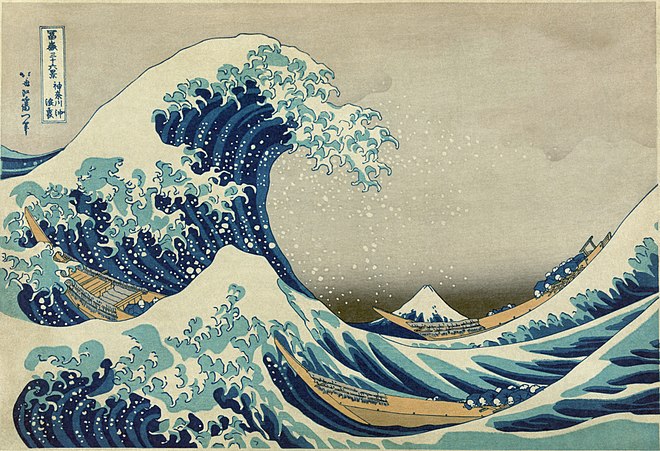
I like to use the work of Hokusai to discuss the awesome use of scale. His 36 Views of Mount Fuji is a fascinating collection and features the famous Under the Wave off Kanagawa - another demonstration of how scale can be used to communicate a message visually.

- Patrick
This could be a whole unit in any art class, with a studio print-making component and a great art history component with cultural and social investigations as well as visual analysis.

I like to use the work of Hokusai to discuss the awesome use of scale. His 36 Views of Mount Fuji is a fascinating collection and features the famous Under the Wave off Kanagawa - another demonstration of how scale can be used to communicate a message visually.
- Patrick
Wednesday, September 13, 2017
Gallery Lookalikes
This is just a fun post that I couldn't resist sharing: gallery lookalikes from Bored Panda.
I'm not sure if this would work with students as an art history scavenger hunt to find their own lookalikes- I think it would depend on the group of students- but it would be so much fun if it did work out!
- Patrick
I'm not sure if this would work with students as an art history scavenger hunt to find their own lookalikes- I think it would depend on the group of students- but it would be so much fun if it did work out!
- Patrick
Saturday, May 27, 2017
A.G.O. Field Trip Planner

Earlier in the school year, I created this A.G.O. Field Trip Planner for teachers, highlighting some of connections that can can made to various Ontario secondary curriculum- not just for Visual Arts classes!
Several of the teachers that I work with used this to plan fun and rewarding field trips. The A.G.O. changes/updates their programming so be sure to check their site for more info: A.G.O.
- Patrick
Wednesday, April 26, 2017
"What is art for? Alain de Botton's animated guide"
Cheers,
Patrick
Sunday, March 27, 2016
A few wonderful artists to check out:
I find so many inspirational artists online- in this post I'll share a few of the ones I've found recently. In our daily online exploration, we are inundated with images and works from a seemingly endless stream of artists. It is important to slow down and appreciate them sometimes.
An idea for a class activity:
Have students research and explore art sites online and make a list of 10 artists that inspire them. Using curriculum/project-specific criteria, have them narrow down their list to the 3 most inspirational and course-relevant artists. Have them prepare a brief slide show presentation with examples of the artists' work, a bio and 1 example of the application of the critical analysis process to analyze 1 work from each of their chosen artists.
Here are 3 that I choose:
Dan McCarthy: http://www.danmccarthy.org
Beth Zaiken: http://www.bethzaiken.com/projects.html
Song Kang: http://www.song-kang.com
Enjoy!
- Patrick
An idea for a class activity:
Have students research and explore art sites online and make a list of 10 artists that inspire them. Using curriculum/project-specific criteria, have them narrow down their list to the 3 most inspirational and course-relevant artists. Have them prepare a brief slide show presentation with examples of the artists' work, a bio and 1 example of the application of the critical analysis process to analyze 1 work from each of their chosen artists.
Here are 3 that I choose:
Dan McCarthy: http://www.danmccarthy.org
Beth Zaiken: http://www.bethzaiken.com/projects.html
Song Kang: http://www.song-kang.com
Enjoy!
- Patrick
Thursday, October 1, 2015
Art History through Thor
THOR: A History of Media and Art from an ancient story to a contemporary film
We start with a story.
Thor comes from Norse mythology. Norse mythology represents the spiritual beliefs of the ancient Germanic and Viking peoples. These stories are made of important metaphors, lessons, and beliefs that were put into poetry, so they could be memorized and passed on.
For hundreds of years it was passed down orally, spoken from one generation to the next. Verbal storytelling was the dominant media of the time.
A brief overview of the story:
Thor is the God of thunder, lightning, storms, strength, healing, oak trees and the protector of humanity. He is the son of Odin, who is the God of Gods. Thor’s trickster brother, Loki, is evil and conflicted. They live in Asgard, one of the nine worlds that are connected by the World Tree.
These characters and this story still has an effect on all of us, it’s where we get the names for Wednesday and Thursday.
Before writing on paper became a dominant form of media, the Germanic and Norse people would carve on stones to tell their story.

Thor’s hammer was worn as a pendant for luck and to symbolize their beliefs. These were made of metal during the 9th and 10th centuries.


Then in the 11th century the stories were written down in a book, and illustrated. The book is called the Poetic Edda. Here is a version that was done in 1908:

When printing was developed, in the 15th century, writing and images became available across greater distances. Drawing and painting on paper and canvas became more popular.
This image was first published in 1555.

This painting, done in oil on canvas was made in 1872. Many other paintings, sculptures, poems and stories have been created about this story since.

In the late 1800’s and early 1900’s, black and white illustration became one of the dominant forms of media, to accompany writing. Here is an illustration of Thor from 1902.

In 1962, Stan Lee created the character of Thor for Marvel comics, drawn by Jack Kirby, written by Larry Lieber. Comics have been a popular form of story-telling from the time these were made up to today.

Kirby’s Asgard

Kirby’s Thor

Before the film was made, many artists worked on transforming the story
into images that would work in a film.
One of these artists is storyboard artist Federico D’Alessandro (head storyboard artist, and animatic supervisor Marvel Studios for Thor, The Avengers, Iron Man 3 and others).

He started the process by creating storyboards based on the script.

Other artists would be working on character development and set design as well, such as Production Illustrator Craig Shoji. He helped develop the environments.


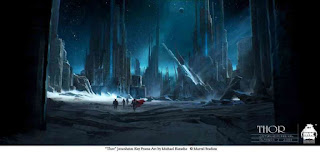
Another artist worked mostly on character design, Michael Kutsche.


After the filming is done, post-production will add special effects and animation.
After the film is complete, the marketing becomes the important media. A central part of the marketing campaign is the internet presence of the project. One of the most important parts of the internet presence is the film’s website: thor.marvel.com.

We start with a story.
Thor comes from Norse mythology. Norse mythology represents the spiritual beliefs of the ancient Germanic and Viking peoples. These stories are made of important metaphors, lessons, and beliefs that were put into poetry, so they could be memorized and passed on.
For hundreds of years it was passed down orally, spoken from one generation to the next. Verbal storytelling was the dominant media of the time.
A brief overview of the story:
Thor is the God of thunder, lightning, storms, strength, healing, oak trees and the protector of humanity. He is the son of Odin, who is the God of Gods. Thor’s trickster brother, Loki, is evil and conflicted. They live in Asgard, one of the nine worlds that are connected by the World Tree.
These characters and this story still has an effect on all of us, it’s where we get the names for Wednesday and Thursday.
Before writing on paper became a dominant form of media, the Germanic and Norse people would carve on stones to tell their story.

Thor’s hammer was worn as a pendant for luck and to symbolize their beliefs. These were made of metal during the 9th and 10th centuries.


Then in the 11th century the stories were written down in a book, and illustrated. The book is called the Poetic Edda. Here is a version that was done in 1908:

When printing was developed, in the 15th century, writing and images became available across greater distances. Drawing and painting on paper and canvas became more popular.
This image was first published in 1555.

This painting, done in oil on canvas was made in 1872. Many other paintings, sculptures, poems and stories have been created about this story since.

In the late 1800’s and early 1900’s, black and white illustration became one of the dominant forms of media, to accompany writing. Here is an illustration of Thor from 1902.

In 1962, Stan Lee created the character of Thor for Marvel comics, drawn by Jack Kirby, written by Larry Lieber. Comics have been a popular form of story-telling from the time these were made up to today.

Kirby’s Asgard
Kirby’s Thor

Before the film was made, many artists worked on transforming the story
into images that would work in a film.
One of these artists is storyboard artist Federico D’Alessandro (head storyboard artist, and animatic supervisor Marvel Studios for Thor, The Avengers, Iron Man 3 and others).

He started the process by creating storyboards based on the script.

Other artists would be working on character development and set design as well, such as Production Illustrator Craig Shoji. He helped develop the environments.


After the filming is done, post-production will add special effects and animation.
After the film is complete, the marketing becomes the important media. A central part of the marketing campaign is the internet presence of the project. One of the most important parts of the internet presence is the film’s website: thor.marvel.com.
Saturday, February 22, 2014
Celtic Knots

I would break the unit up into three main tutorials, leading to a culminating task. The first lesson would introduce the project with some cultural background and a look at the art history of the Picts and the Gaels. This would show students the cultural context of the work and how math and patterns are used in design- on paper and in stone.


The first lesson would end by watching a demonstration or video- the first tutorial. This would give students a chance to practice the initial exercises and create their first knot based on a simple rectangle.
A clear and easy to follow video can be found here, and a variation can be created for demonstration http://www.youtube.com/watch?v=xce8NSx3AKo.

The second lesson would start with a review of the first tutorial and the art history and then a look at the second tutorial. The students would then spend some time working in their sketchbooks on the next exercises.
The third lesson would build on the first two with a more complicated knot. This would be a longer project, lasting at least three classes- and ending with the submission of the culminating task.

- Patrick
Friday, December 27, 2013
Illustration Unit: Howard Pyle

The next illustrator to study in this unit is the influential american artist, writer and art teacher Howard Pyle. He started teaching at a young age and many of his students became successful artists including N.C. Wyeth. Pyle and his followers have been termed the "Brandywine School" after the region they lived in.

His work demonstrates realism with a sophisticated use of colour and composition. His images also feature recurring themes of patriotism.


One of his well-known works, The Merry Adventures of Robin Hood, he both wrote and illustrated.


Saturday, December 21, 2013
Illustration Unit: Willy Pogany

I started this blog for in-class art projects and lesson plans. Lately it's been all about field trips - and I've covered a few art gallery shows in between. I want to get back to posting about in-class activities and good starting points for projects.
The golden age of illustration would make a great theme for a studio project and a long-term art history section. This high-point of traditional commercial art featured work by english artists including: Aubrey Beardsley and Arthur Rackham and american artists including: Howard Pyle, N.C. Wyeth and Maxfield Parrish.

This post presents a personal favourite Willy Pogany, originally from Hungary, who started his career in England and then moved to the US.


Willy Pogany illustrated many wonderful narrative books covering myths and legends, fairy tales and adventure stories. He works with pen and ink on smooth paper using short expressive line-work and an art nouveau design approach. His work features beautiful examples of hand-lettering.

A fun studio project: students choose a myth or legend from any culture to research and illustrate one scene from the story. A title or quote must be included in the design using hand-lettering. Students can also choose from folk stories, fairy tales and adventure books.
Students will complete a Creative Process Booklet to be submitted with the final work that will present the brainstorming, research, experimentation, rough work and reflection.
Lesson One: Intro to the Golden Age of Illustration
Lesson Two: pen and ink basics
Lesson Three: pen and ink techniques
Lesson Four: hand-lettering techniques
Lesson Five: The work of Willy Pogany
Lesson Six-Ten: Studio project: The Creative Process
Lesson Eleven: Final Submission - Class Presentation and Group Critique
Subscribe to:
Posts (Atom)