Showing posts with label The Elements and Principles of Design. Show all posts

Wednesday, May 8, 2019

Friday, March 15, 2019

Coco Oil Pastel scratch-board project

Recently my class had a great time making their own scratch-board using oil pastels. We used the "Land of the Dead" from the movie Coco as inspiration for a colourful, geometric, fantasy landscape.

Step 1: use warm coloured crayons to colour a white sheet of paper
Step 2: cover the crayon completely with black oil pastel
Step 3: use a toothpick to draw (scratch away) a geometric landscape to reveal the colour beneath

This is great way to use a new technique with different materials and practice using the principle of design: contrast and the elements of design: colour, shape and form.

Here are some examples of student work:


Patrick

Saturday, November 10, 2018

The Principle of Design: Pattern

As I work through the elements and principles of design with my students, I try to find engaging and achievable projects to highlight the potential of each. The School of Islamic Geometric Design is a great site for patterns and got some fantastic ideas for a memorable pattern design studio project here: http://www.sigd.org/resources/pattern/

There are so many beautiful patterns all around the Aga Khan Museum. It would be great to include a field trip to the museum to explore pattern and find inspiration.

I first visited the museum a few years ago, see some photos in a previous post: here.

Patrick

Wednesday, February 28, 2018

Teachers Pay Teachers

There are some great resources on the site Teachers Pay Teachers, for basically any content, level and detail you want to teach. It's great for ideas, activities and plans to get you started and to make your own for any class.


Recently I've been using some of the resource and I've added my Elements and Principles of Design worksheets, as well as a full Elements and Principles of Design Unit Plan, complete with lesson plans, suggested art studio activities and art history examples.

Cheers!

Patrick

Sunday, September 17, 2017

Japanese woodblock database- a digital archive

Thanks to Open Culture for posting about this fantastic collection of Japanese woodblock prints.

This could be a whole unit in any art class, with a studio print-making component and a great art history component with cultural and social investigations as well as visual analysis.


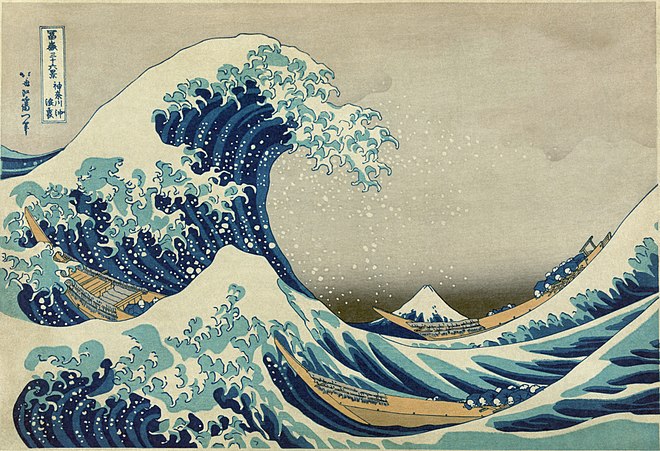
I like to use the work of Hokusai to discuss the awesome use of scale. His 36 Views of Mount Fuji is a fascinating collection and features the famous Under the Wave off Kanagawa - another demonstration of how scale can be used to communicate a message visually.


- Patrick

Tuesday, February 28, 2017

Prints for order of The Elements & Principles of Design!

By far my most viewed post is about some classroom handouts that I made to teach the elements and principles of design.  I have them printed larger for my classroom and I wanted to make it easy for others to be able to order them printed at various sizes, and in higher resolution. They're available for order here:

The Elements of Design

The Principles of Design

A full Elements and Principles of Design Unit plan (complete with lesson plans) is also available on my Teachers Pay Teachers site, here.

The letter-size worksheets by themselves (without the lesson plans) are available on my Teachers Pay Teachers site, here.


- Patrick

Saturday, October 3, 2015

5 Year Anniversary!

This blog turns 5 years old this month! I have been updating Split Complementary with art education resources, lesson ideas, inspiration and local events since I was in teacher's college in 2010.

Now there are 108 posts and I hope to keep on going. Thanks to all the educators and visitors for checking out the blog! The most visited post has been: the Elements and Principles of Design.

Cheers!

- Patrick

Thursday, December 25, 2014

Studio Project: From a freehand sketch to a finished work in three stages

Merry Christmas & happy holidays!

I finished this one a few days ago and had a lot of fun making it- it's called "New King" and is based on some photos I took of a great tree just off of Steeles Ave. in Toronto. 

Stage 1: Freehand sketch
Students brainstorm an idea for a sketch and collect reference images as research. Next, students work out a rough sketch, considering composition and any elements and principles of design to use in the project.


Composition: off-centred; focus on the crown of the tree
Elements of Design used:  line, shape, form, texture
Principles of Design used: contrast, variety, emphasis


Stage 2: Refined Sketch
Students work up their freehand sketch and then draw over it with ink. Transferring the image or using a lightbox might be required.


Stage 3: Finished work
Students colour and complete the final work from the refined sketch. Suggested media, any one of the following: Photoshop, Illustrator, Watercolour, pencil crayons, markers, pastels.


Friday, August 31, 2012

New and improved Elements and Principles of Design icons


Here are my new updated elements & principles of design sheets. I've added a few terms from the ministry documents that were missing on the original and I changed the icon. 

A full Elements and Principles of Design Unit plan (complete with lesson plans) is available on my Teachers Pay Teachers site, here.

The letter-size worksheets by themselves (without the lesson plans) are available on my Teachers Pay Teachers site, here.

I also have high-quality prints of these charts available for purchase here:


- Patrick

Monday, February 6, 2012

The Elements & Principles of Design Icons


These are handouts that I created for my practicum in visual arts this fall. I had the chance to teach the elements & principles unit for grade 9 and 10 and faced the challenge of trying to make these terms easily accessible for a range of students.

I found that by going though each element and principle with examples from art history, and then applying this in a studio session, the students got the concepts. The problem was then being able to remember them all.

I tried these handouts and they worked surprisingly well. I gave out blank versions, and had the students fill out each term and definition as we covered them in class. The important part is the final step, the icon, where I asked students to come up with an icon that mattered to them, and that they felt comfortable drawing. This way, the terms were reinforced with an immediate visual reference that is more memerorable than a definition- the handouts also work well as a study sheet for the final exam.

A full Elements and Principles of Design Unit plan (complete with lesson plans) is also available on my Teachers Pay Teachers site, here.

The letter-size worksheets by themselves (without the lesson plans) are available on my Teachers Pay Teachers site, here.


- Patrick