Saturday, February 22, 2014

Celtic Knots


I've always wanted to do a class project on celtic knots. They look complicated but they are actually fairly easy to do. The trick is to create some guides and grids to use as a basis for the knot-work.

I would break the unit up into three main tutorials, leading to a culminating task. The first lesson would introduce the project with some cultural background and a look at the art history of the Picts and the Gaels. This would show students the cultural context of the work and how math and patterns are used in design- on paper and in stone.


The first lesson would end by watching a demonstration or video- the first tutorial.  This would give students a chance to practice the initial exercises and create their first knot based on a simple rectangle.

A clear and easy to follow video can be found here, and a variation can be created for demonstration http://www.youtube.com/watch?v=xce8NSx3AKo.


The second lesson would start with a review of the first tutorial and the art history and then a look at the second tutorial. The students would then spend some time working in their sketchbooks on the next exercises.

The third lesson would build on the first two with a more complicated knot. This would be a longer project, lasting at least three classes- and ending with the submission of the culminating task.


- Patrick

Sunday, January 19, 2014

A few helpful teaching links

I found this post a year ago and have used some of these strategies in my classroom. This is a list of ways to bring art into any lesson to add creativity and a hands-on approach to learning:
http://www.opencolleges.edu.au/informed/features/50-ways-to-integrate-art-into-any-lesson/

This next link is to a fantastic contemporary art blog: booooom- the specific post shows the work of an artist that uses flowers to create mandalas. I am putting together a mandala mural project for a grade 9 and 10 class, so I will be posting more about that project later. For now, here is some inspiration:
http://www.booooooom.com/2012/07/10/flower-mandalas-by-kathy-klein/

This last link is to a wonderful tumblr all about illustration:
http://artofnarrative.tumblr.com/page/102

- Patrick

Monday, December 30, 2013

Illustration Unit: Maxfield Parrish


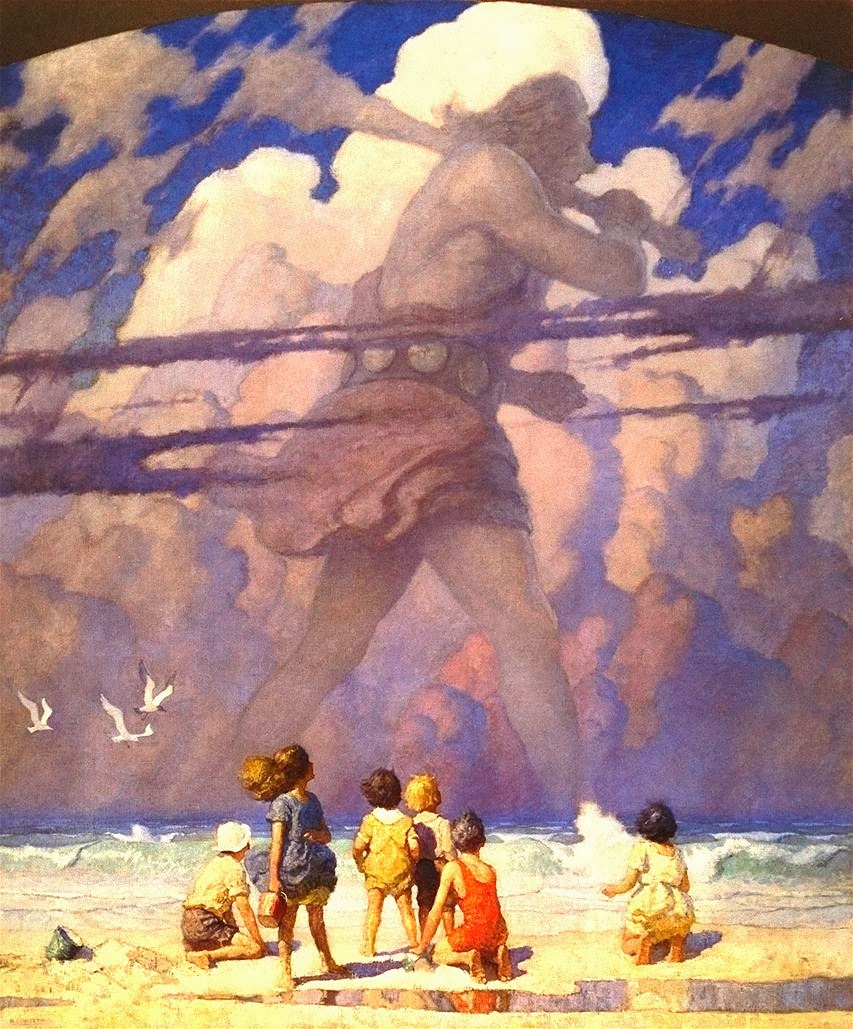
The last illustrator of the Golden Age for the unit is Maxfield Parrish, another influential american artist who worked in book illustration and commercial art during the first half of the twentieth century.


He is known for his intense use of colour; neoclassical figures and drapery; big open skies full of stratocumulus clouds; and painstaking three-dimensional realism achieved through extensive glazing with oil paints.


Sunday, December 29, 2013

Illustration Unit: N.C. Wyeth


One of the biggest american illustrators is N.C. Wyeth (Newell Convers). He was a gifted artist as a child and went to a few art colleges before joining Howard Pyle's art school when he was twenty years old. Within a few months, he was commissioned to do a cover for the Saturday Evening Post and his career took off from there.


He went on to produce over 3000 illustrations and 112 books in his career. He also started a family of artists, with his son Andrew Wyeth becoming one of the important american fine artists of the second half of the 20th century. Interestingly, his grandson Howard Pyle Wyeth, was the drummer for Bob Dylan for a while.


N.C. Wyeth responded well to Pyle's approach to illustration and his influence can be seen throughout his work. Thematically, he continued in Pyle's tradition of americana and adventure book illustration full of pirates, native americans and Robin Hood. He also worked extensively creating magazine illustrations and advertisements. His images demonstrate an exploration of Pyle's focus on realism and an expressive use of colour within a strong composition.


Friday, December 27, 2013

Illustration Unit: Howard Pyle


The next illustrator to study in this unit is the influential american artist, writer and art teacher Howard Pyle. He started teaching at a young age and many of his students became successful artists including N.C. Wyeth. Pyle and his followers have been termed the "Brandywine School" after the region they lived in.


His work demonstrates realism with a sophisticated use of colour and composition. His images also feature recurring themes of patriotism.


Like Rackham and Pogany, Pyle's focus was on children's stories and adventure books and he has been credited with developing the typical image of the pirate.


One of his well-known works, The Merry Adventures of Robin Hood,  he both wrote and illustrated.


Thursday, December 26, 2013

Illustration Unit: Aubrey Beardsley


The next illustrator I would cover in the art history part of the unit is the english artist Aubrey Beardsley. His work is a good example of the influence of Japanese woodcuts on European art in general on the art nouveau movement in particular.


After studying Pogany and Rackham, Aubrey Beardsley presents a different approach to illustration. His work is a great example of the power of contrast and the beauty of using shape and line. 


He offers another approach to hand-lettering that students can refer to during the research stage of the Creative Process.
  

Wednesday, December 25, 2013

Illustration Unit: Arthur Rackham


Arthur Rackham is another great illustrator to study from the Golden Age. His work, like Pogany's, focuses on myths, legends and fairy tales.


For the Illustration Unit, I would cover Arthur Rackham (and a few other central artists) in the introductory powerpoint/ slide-show during the first lesson. Then I would refer back to his work throughout the studio project, for inspiration and to help with ideas about technique.